L4-L5 Disc Bulge Treatment: Understanding Your MRI and Recovery Options
If your doctor or MRI report mentions an L4-L5 disc bulge, you might wonder what it means and how to recover safely. The good news is that L4-L5 disc bulge treatment doesn’t always require surgery. In most cases, conservative and evidence-based physiotherapy for L4-L5 disc bulge treatment can help you return to pain-free movement naturally.
What Is an L4-L5 Disc Bulge?
Your spine is made up of vertebrae (spinal bones) separated by intervertebral discs that act as cushions. Each disc has:
- Nucleus pulposus – a jelly-like core.
- Annulus fibrosus – a tough outer wall.
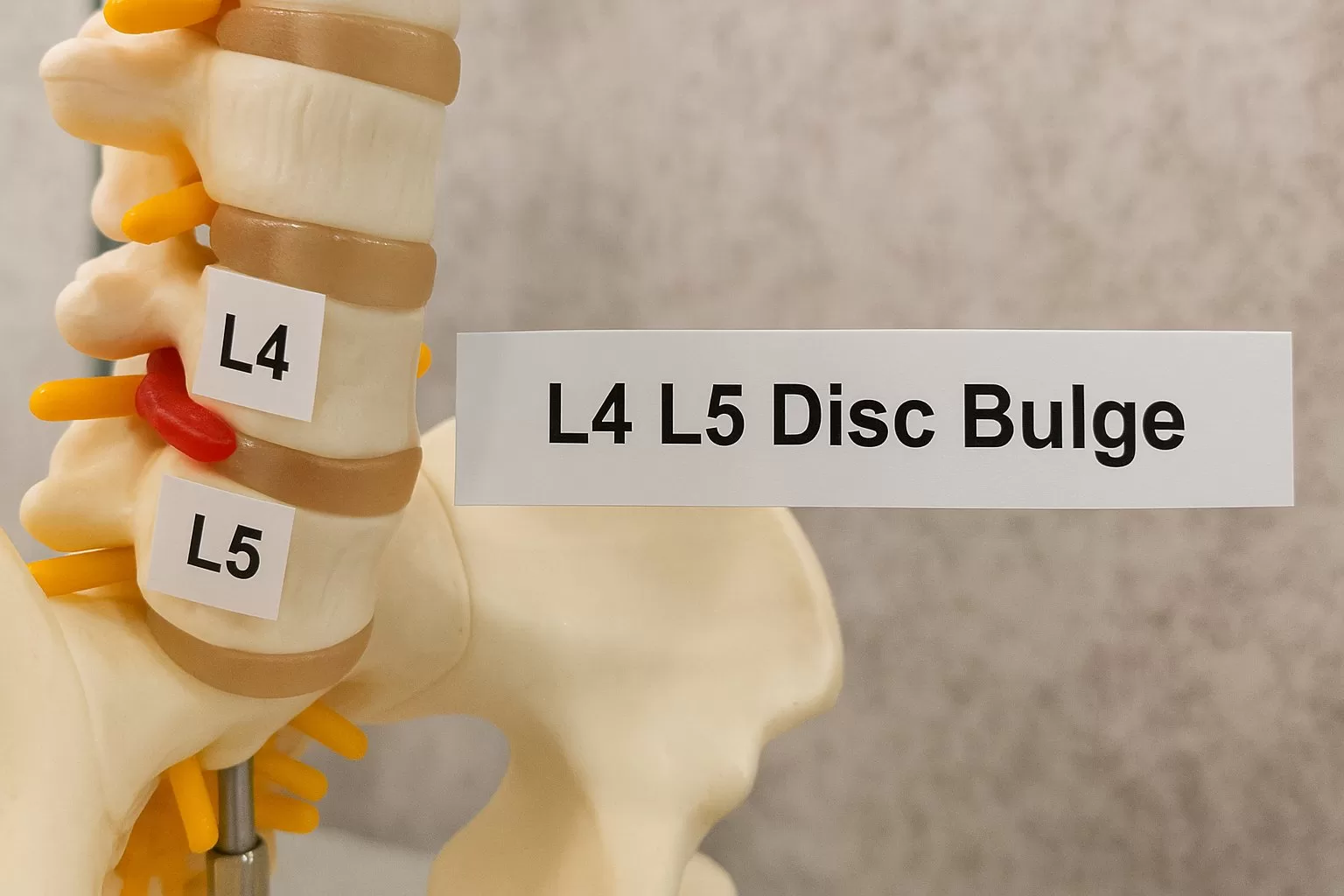
When the disc between the L4 and L5 vertebrae weakens, the inner material pushes outward. If the outer wall bulges but doesn’t rupture, it’s called a disc bulge.
Think of it like pressing a jelly doughnut – the dough bulges outward, but the filling doesn’t leak.
An MRI showing an L4-L5 disc bulge means the disc is protruding and may press on nearby nerves. The sciatic nerve is often affected, causing:
- Lower back pain
- Pain radiating down the leg (sciatica)
- Tingling or numbness in the feet
- Muscle weakness in the legs
Some disc bulges are “silent” and cause no symptoms. Pain depends on the size, direction, and location of the bulge.
Severity of L4-L5 Disc Bulge
The severity of a disc bulge can vary:
- Mild – Small protrusion, often symptom-free
- Moderate – Larger bulge, may irritate nerves
- Severe – Significant nerve compression, often causing weakness or numbness
Red Flag Symptoms (Seek Immediate Care):
- Sudden loss of bladder or bowel control
- Severe weakness in both legs
- Persistent pain not relieved by rest or medicine
Most L4-L5 disc bulges are mild to moderate and improve with conservative treatments like physiotherapy, medication, and lifestyle adjustments.
Types of L4-L5 Disc Bulge
- Diffuse bulge – Bulges evenly around the disc
- Focal bulge – Localized bulge at one point
- Central bulge – Toward the spinal canal
- Paracentral bulge – Slightly off-center, may compress the sciatic nerve
- Foraminal bulge – Toward the nerve exit hole
Symptoms of L4-L5 Disc Bulge
- Back pain that worsens with sitting, bending, or lifting
- Sciatica – Sharp or burning pain in the buttock, thigh, or foot
- Tingling or numbness in the legs or toes
- Muscle weakness, especially in the ankle or foot
- Stiffness and reduced spinal flexibility
L4-L5 Disc Bulge Treatment Options
Conservative Care (Non-Surgical)
- Rest & Posture Correction – Avoid prolonged sitting or bending forward
- Medications – Pain relievers, anti-inflammatories, muscle relaxants
- Heat & Cold Therapy – Ice for inflammation, heat for stiffness
- Physiotherapy – Stretching, strengthening, and spinal mobility exercises
- Lifestyle Changes – Weight management, ergonomic adjustments
- Epidural Steroid Injections – For persistent pain
General Guidelines for All Disc Bulges:
- Stay active; avoid long bed rest
- Perform core-strengthening exercises
- Consider minimally invasive treatments if needed
- Surgery only if all else fails
When Is Surgery Needed?
Surgery is considered if:
- Severe nerve compression causes progressive weakness
- Pain does not improve after 3–6 months of treatment
- Red flag symptoms (loss of bladder/bowel control) appear
Surgical Options:
- Microdiscectomy – Removes the bulging portion of the disc
- Laminectomy – Removes part of the vertebra to relieve pressure
- Spinal Fusion – Rare, used for spinal instability
Post-surgery physiotherapy is essential for optimal recovery.
Can I Avoid Surgery with L4-L5 Disc Bulge Treatment?
Yes, most patients can avoid surgery. Studies show that over 80–90% improve with conservative care. Dedicated L4-L5 disc bulge physiotherapy programs can be helpful.
While the disc may not fully return to normal, your body can:
- Reduce inflammation around nerves
- Strengthen supporting muscles to prevent future issues
- Reabsorb part of the bulge naturally
How to Promote Healing
- Perform daily physiotherapy exercises
- Maintain an active lifestyle
- Eat an anti-inflammatory diet
- Practice proper sitting and sleeping postures
How Physiotherapy Helps in L4-L5 Disc Bulge Treatment
Modern physiotherapy for L4-L5 disc bulge uses a combination of techniques to promote healing. At O2D3 Physiotherapy in Chennai, experts guide patients through safe recovery steps — from pain management to posture retraining — ensuring long-term spine stability.
A physiotherapist will design a personalized program that includes:
1. Pain Relief Methods
- Ice/heat therapy
- Ultrasound or TENS (electrical stimulation)
- Manual therapy or gentle spinal mobilization
2. Exercise Therapy
- Core strengthening (planks, pelvic tilts)
- Flexibility training (hamstring and hip stretches)
- McKenzie extension exercises
3. Posture & Ergonomics
- Correct sitting and standing techniques
- Workstation setup adjustments
- Safe lifting methods
4. Functional Training
- Gradual return to daily activities
- Long-term habits to prevent recurrence
The goal is not only pain relief but also long-term spine health and prevention of future disc problems.
References
- Vroomen, P.C.A.J., & Koes, B.W. (2010). Diagnosis and treatment of sciatica. BMJ Clinical Evidence. Learn more.
- Konstantinou K, Dunn KM. Sciatica: review of epidemiological studies and prevalence estimates. Spine. 2008 Oct 15;33(22):2464-72. Learn more.
- Machado LA, De Souza MV, Ferreira PH, Ferreira ML. The McKenzie method for low back pain: a systematic review of the literature with a meta-analysis approach. Spine. 2006 Apr 20;31(9):E254-62. Learn more.
- Peul, W.C., et al. (2007). Surgery versus prolonged conservative treatment for sciatica. New England Journal of Medicine, 356, 2245–2256. Learn more.
FAQs on L4-L5 Disc Bulge
Is it okay to sleep on my back with a disc bulge at L4-L5?
Yes, with a pillow under your knees for support. This helps maintain the natural curve of your lower back and reduces pressure on the affected disc.
Can I lift heavy weights with a disc bulge at L4-L5?
No, avoid heavy lifting. Lifting heavy weights can strain your lower back and exacerbate your symptoms. Stick to lighter weights or bodyweight exercises that don’t put excessive pressure on your spine.
Where can I get the best physiotherapy in Chennai for L4-L5 disc bulge?
Clinics like O2D3 Physiotherapy in Chennai specialize in non-surgical spine rehabilitation through evidence-based and personalized programs.
Is walking a suitable form of exercise for managing a disc bulge at L4-L5?
Yes, it can help improve mobility and strengthen muscles. Walking is a low-impact exercise that promotes blood flow and can alleviate symptoms associated with a disc bulge. Start with short walks and gradually increase duration and intensity as tolerated.
Can I sit for long periods with a disc bulge at L4-L5?
No, prolonged sitting can increase pressure on your lower back and worsen symptoms. Take frequent breaks to stand, stretch, or walk around.
Can I engage in yoga or Pilates with a disc bulge at L4-L5?
Yes, but choose classes or poses that focus on gentle stretching and core strengthening. Avoid poses that involve excessive twisting or forward bending.
Should I avoid twisting or bending movements with a disc bulge at L4-L5?
Yes, sudden twisting or bending movements can strain your spine and aggravate your symptoms. Move slowly and mindfully, avoiding excessive or jerky movements.